
If the first story explained how the 100 Gig Challenge works, the second reveals why it continues to grow.
Inside the York music wing, the Gig-o-meter keeps track of performances, but the growth happening behind those numbers is harder to quantify. For freshman Nicholas Deligiannis, that growth starts in a brass quintet rehearsal room with no director standing in front.
“Our band is divided into chamber groups,” Deligiannis said. “Usually it’s one person on each part. We find our own music, rehearse it together, and then go out into the community and perform.”
With only five musicians and no conductor guiding entrances, there is little room to blend in. Every note carries weight, and every mistake is exposed.
“It’s a little more nerve-wracking because there’s fewer of you, so mistakes are easier to hear,” Deligiannis admitted. “But it’s also really cool because random people walking by can stop and listen. You’re reaching more people. It feels very fulfilling.”
That mix of vulnerability and purpose is something freshman Kelly Cervantes felt immediately. She expected the spotlight to feel overwhelming, especially in a smaller group setting.
“At first, I thought it would be really nerve-wracking because it’s just focused on you and whoever you’re playing with,” Cervantes said. “But once I saw how supportive everyone was, it wasn’t as stressful as I thought.”
What began as anxiety gradually turned into ownership. Cervantes now rehearses during lunch, stays after school, and even texts her ensemble about potential repertoire changes.
“I feel like it’s gone to all aspects of my life,” she said.
For freshmen Emily Saldanha and Yiorgos Malamis, the difference becomes most clear during community performances at places like the Elmhurst Public Library. The audience is not obligated to attend; they choose to stop and listen.
“It’s really nice to go to the library and play for people who want to hear the music,” Malamis said. “It’s nice to give them what they want.”
That audience awareness sharpens preparation. In a small group, Saldanha said, musicians cannot rely on surrounding sections to cover imperfections.
“You have to actually really know your music because you can’t hide anywhere,” she said. “In a big band, you can blend in. In a small group, it’s just you. You’re heard.”
By junior year, the shift becomes more philosophical. Daniel Lattas sees a clear difference between playing for a familiar school crowd and performing for a broader community.
“At school, you’re playing for people you know,” Lattas said. “But in the community, you’re reaching a new crowd. They’re invested. They hear the music and want to listen. That really spikes the motivation to play.”
Preparation, he explained, feels less like studying alone for a test and more like collaborative problem-solving.
“You’re challenging each other’s ideas,” Lattas said. “If someone says, ‘We should be louder here,’ and someone else says, ‘Maybe quieter,’ we talk about it. Whatever sounds more right musically, that’s what we go with.”
That exchange forces students to articulate their instincts and refine them in real time.
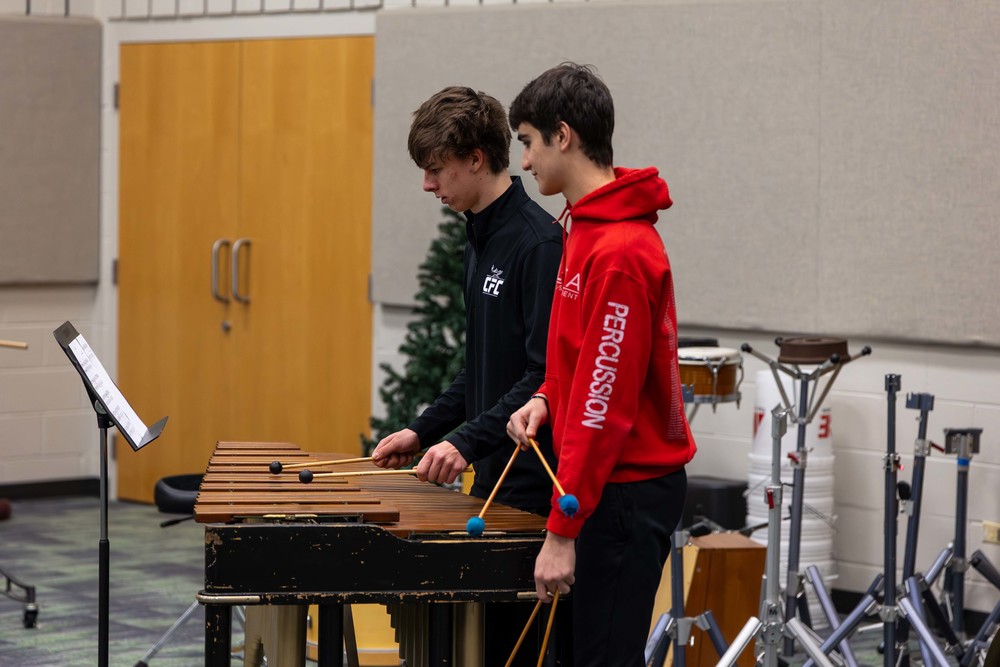
For senior George Redfearn, that refinement has led to some of the most memorable performances of his high school career. Last year, he and York junior Ved Sule performed a marimba duet on the same instrument, facing one another from opposite sides. The piece was calm and emotional, designed specifically for a community setting.
“It was a really emotional piece,” Redfearn said. “Percussion doesn’t always get opportunities in small ensembles, but this allowed us to create something meaningful for the library.”
Experiences like that reinforce what he describes as mutual benefit. “We get more experience playing live, and the community gets to see what the local high school is creating,” Redfearn said.
Sule remembers one particular moment when that benefit felt tangible.
“When we performed at the library, I had someone I’d never met come up to me and say my music meant something to them,” Sule said. “That was really special.”
Small groups intensify those connections. “In a small group, there’s less space to hide,” Sule added. “You have to project yourself more. It builds confidence.”
Redfearn describes the transformation more vividly.
“Pressure creates diamonds,” he said. “When you put people in vulnerable situations, they realize what they’re capable of.”
Across grade levels, that vulnerability appears to be the common thread. Freshmen and Sophomores discover accountability. Juniors learn to defend artistic decisions. Seniors leave with confidence forged in intimate rehearsal rooms and public performances.
The 100 Gig Challenge may measure performances, but the students measure something deeper: connection, ownership, and growth. As the number inches closer to 100, the most meaningful progress is unfolding in the quiet moments between notes, when young musicians realize their music belongs not just on a stage, but in their community.